Front - the boundary between two air masses
Cold Front - The leading edge of a cooler and/or dry air mass
- Cold fronts will often come with stronger winds and also provide the lift needed to produce thunderstorms
Warm Front - The leading edge of a warmer and/or moister air mass
- Warm fronts can bring blanketing, light precipitation
Stalled Front - A boundary that has essentially stopped moving
- Can create the lift needed to produce thunderstorms
Centers of Pressure - Within circulations in the atmosphere these are the points where the atmospheric pressure reaches
its highest or lowest
High Pressure System - A circulation in the atmosphere where the Center of Pressure is the highest atmospheric pressure
- Typically associated with calm and clear conditions
- The edges can bring elevated winds
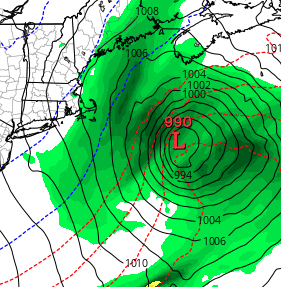
Low Pressure System - A circulation in the atmosphere where the Center of Pressure is the lowest atmospheric pressure
- These are storm systems with common examples being hurricanes and Nor'easters
- The strongest winds are close to the Center of Pressure
Isobar - On a pressure map or chart they are lines that indicate a singular level of pressure
Pressure Gradient Acceleration(PGA) - This is the main force that drives the wind
- It is the way that the atmosphere attempts to balance out pressure differences
- PGA increases when there is a larger change in atmospheric pressure
- Low Pressure Systems tend to have a larger PGA closer to the Center of Pressure
- High Pressure Systems tend to have a lower PGA closer to the Center of Pressure